

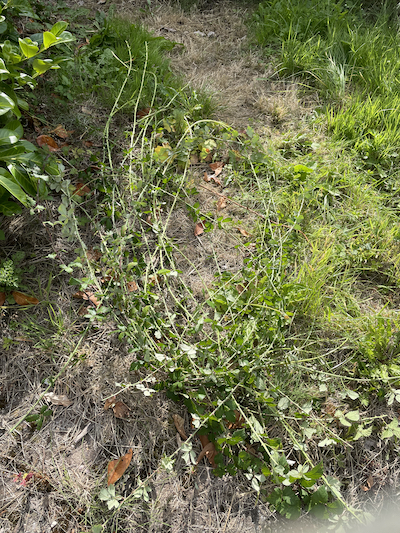
Each autumn we find ourselves trimming back shrubs and hedges, weeding the borders and preparing the garden for winter.
As the piles of cuttings grow, I sift through them for potential weaving materials, twisting and bending, stripping leaves and thorns and generally exploring how I might work them into baskets, wreaths and other items of interest.
This weekend’s haul included a bolognese of bramble runners that were swamping a laurel hedge. They are this year’s growth so they didn’t host blackberries, and they were a lovely soft unbranched green, with soft well spaced thorns. Older brambles are usually more woody and you need to wait until the blackberries are finished. Other varieties can have thousands of very prickly thorns packed onto the stems – I find them impossible to remove with the strippers so I avoid those!
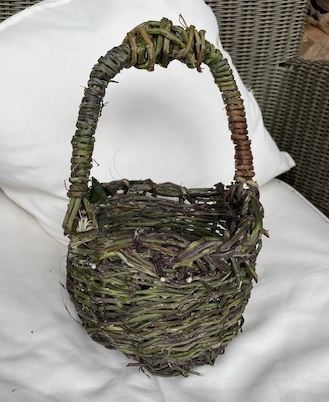
Each runner was from 1.5-3m long so fabulous for weaving with… but what to weave?! A small basket for collecting blackberries of course!
Not the neatest job but for a first attempt I was pleased and next time I will use a different method for the handle and for the rim of the basket.
Next up, a euonymus bush needed a haircut, so with the trimmings I made a flatweave tray. While the trimmings were nice and flexible, they were not long enough to wrap around the frame so the flatweave technique was the best option.
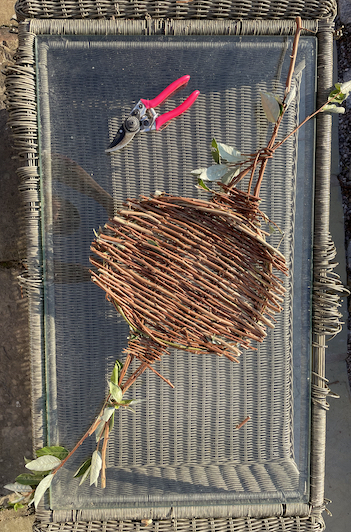
I trimmed the edges rather wide from the frame to allow for shrinkage as the material dries. I suspect it will become a bit loose so I will add more weavers in to fill it out again when it has all dried out.
Walking around the garden perimeter, to my amazement I spotted a vine growing over the top of the hawthorn hedge… upon closer inspection it turned out to be hops! Fabulous weaving material, lovely and flexible yet strong. I clipped off some hawthorn, stripped off the leaves and thorns and used them for the stakes. Then from our white poplar, which grows little twigs from the trunk each year, I wove two of those into a wreath base. The hop vine was woven around the stakes to hold it all together.
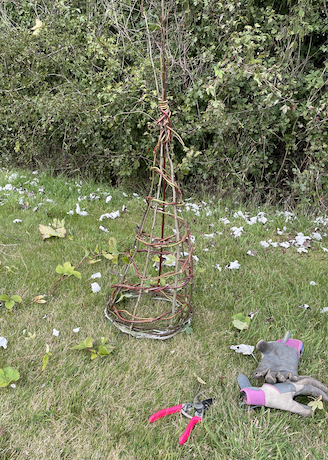
A small garden support ready for perhaps a courgette plant next spring.
Next, a tidy up of a heather border yielded a pile of dread branches. Not flexible enough to weave with as such, but perfect for fluffing up a dried wreath frame I had made last year.
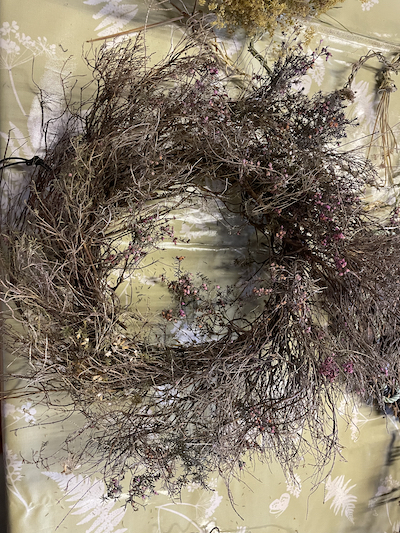
Needs a bit of evening out but you get the idea! I wanted to keep going in the garden and as this is dried material I can come back to it to finish off another time.
Finally, for this session, we had some rushes growing up through a shrub that needed to come out, so I carefully pulled them out stalk by stalk and used a spiral weave technique to make them into a pear!
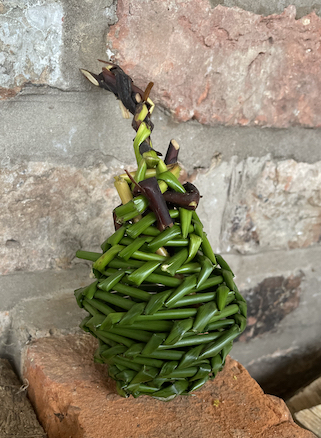
The rushes will dry out to a whitish colour but I have small items from previous years and although they get a bit looser, they do hold together, so fingers crossed for this one too!
If you are interested in experimenting with your garden cuttings, don’t hold back! Try everything and anything. Different techniques will suit different plants. Some plants might work better when they are fresh, others when they are dried. I find plants like hawthorn or hazel are flexible but snap easily when green, but if you wait until their leaves drop off in winter, they are more likely to tolerate the curves and twists without breaking. Remember fresh cuttings will shrink as they dry so may need a bit of filling out later on.
I am very grateful to lovely and clever makers who post videos on YouTube and Pinterest sharing information about ‘wild weaving’ and other weaving projects. With an eye to harvesting materials over winter I have just enjoyed watching some videos from Shedcrafter (YouTube), and reading a blog from foragedfibres (Pinterest).
The most important thing is to give it a go, as you will learn from mistakes as much as from triumphs and hopefully will have some happy surprises along the way!
 sargiesmess.co.uk
Leave a comment